Leaking Faucet Repair in Winston-Salem, NC
Learn about leaking faucet repair in Winston-Salem, NC, including common causes, faucet types, warning signs, repair options, water waste, maintenance, costs, and when to call a plumber.

Leaking Faucet Repair in Winston-Salem, NC
A dripping or leaking faucet can be more than an annoying sound. Continuous water leakage can waste water, contribute to mineral buildup, stain sinks, and indicate that an internal faucet component needs repair or replacement.
Professional leaking faucet repair in Winston-Salem, NC can help identify the source of the leak and restore the fixture to proper operation.
Faucets are used every day in kitchens, bathrooms, laundry areas, and other parts of a home. Normal wear and tear can eventually affect seals, cartridges, washers, handles, valves, and connections.
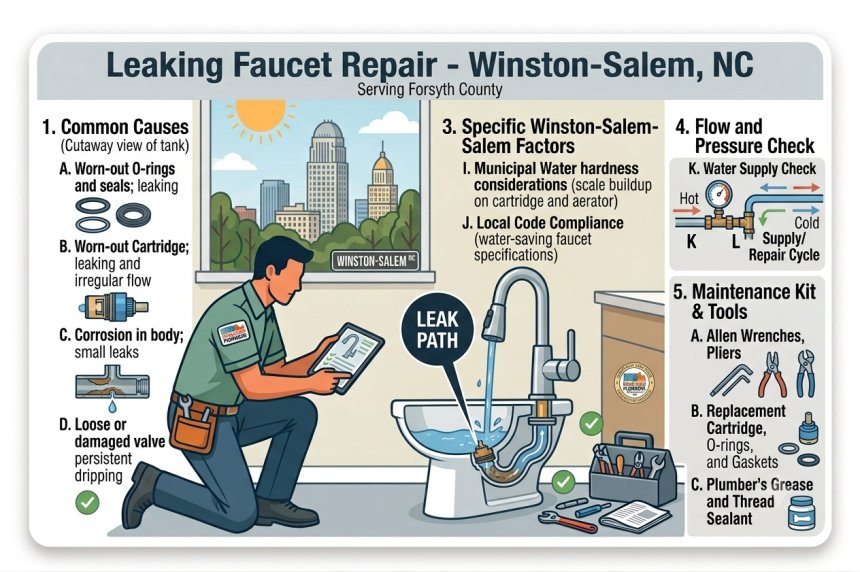
Common Causes of a Leaking Faucet
A faucet may leak for several different reasons.
Common causes include:
- Worn washer
- Damaged O-ring
- Failed cartridge
- Faulty valve
- Loose connection
- Corrosion
- Mineral buildup
- Damaged faucet body
- High water pressure
- Improper installation
The location of the water can help identify the type of problem.
Signs of a Faucet Leak
A faucet leak may appear as a constant drip, but other signs are possible.
These include:
- Water dripping from the spout
- Water around the handle
- Moisture beneath the sink
- Rust or corrosion
- Loose faucet handle
- Reduced water flow
- Water stains
- Damp cabinet surfaces
- Leaking supply connections
A small leak can gradually become more noticeable.
Faucet Dripping From the Spout
If water continues dripping from the faucet spout after the fixture is turned off, an internal sealing component may not be working properly.
Depending on the faucet design, the problem may involve:
- Washer
- Cartridge
- Valve
- O-ring
- Other internal components
Replacing the appropriate worn component may stop the leak.
Faucet Leaking Around the Handle
Water appearing around a faucet handle can indicate a worn seal, cartridge, O-ring, or another internal component.
The repair depends on the faucet design.
In some cases, replacing an internal component can restore the faucet. In other situations, the entire fixture may be too damaged or corroded for practical repair.
Leaking Faucet Under the Sink
A faucet can also leak below the sink.
Possible sources include:
- Supply line connections
- Faucet mounting connections
- Flexible hoses
- Shutoff valves
- Corroded fittings
- Drain-related components
Water beneath the sink should be investigated because prolonged moisture can damage cabinets and stored items.
Kitchen Faucet Leaks
Kitchen faucets experience frequent use and can eventually develop leaks.
Common problems include:
- Dripping spout
- Loose handle
- Pull-down sprayer leaks
- Hose connection leaks
- Base leaks
- Supply connection problems
Professional kitchen faucet repair can help determine whether the issue involves the faucet itself or the surrounding plumbing.
Bathroom Faucet Leaks
Bathroom faucets can develop similar problems.
A leaking bathroom faucet may involve:
- Worn cartridge
- Damaged washer
- Loose handle
- Corroded valve
- Supply connection
- Faucet body
Prompt repair can help prevent water damage and unnecessary water usage.
Why Faucet Leaks Should Not Be Ignored
A dripping faucet may seem insignificant, but continuous leakage can add unnecessary water consumption over time.
Leaks beneath a sink can be even more concerning because they may remain unnoticed for longer periods.
Ignoring a leak can contribute to:
- Water waste
- Higher utility costs
- Mineral stains
- Cabinet damage
- Corrosion
- Mold or moisture-related problems
Repairing the leak early can help limit these issues.
Professional Leaking Faucet Repair Process
A plumber may begin by identifying exactly where the water is coming from.
The process may include:
- Inspecting the faucet
- Checking handles and controls
- Testing water flow
- Inspecting connections
- Checking internal components
- Looking for corrosion
- Identifying the source of the leak
- Replacing damaged parts
- Testing the repaired faucet
- Checking surrounding connections
The repair method depends on the faucet type and condition.
Common Types of Faucets
Different faucet designs use different internal mechanisms.
Common types include:
- Compression faucets
- Cartridge faucets
- Ball faucets
- Ceramic-disc faucets
- Single-handle faucets
- Two-handle faucets
- Pull-down faucets
- Pull-out faucets
Knowing the faucet type can help determine which replacement components may be required.
Repair or Replace the Faucet?
A leaking faucet does not always need to be replaced.
Repair may be practical when:
- The faucet body is in good condition
- Replacement parts are available
- The leak comes from a replaceable component
- The fixture is relatively new
Replacement may be considered when:
- The faucet is heavily corroded
- Multiple components have failed
- The fixture has repeated problems
- Replacement parts are difficult to obtain
- The faucet is severely damaged
A plumber can assess the fixture and explain the available options.
Water Pressure and Faucet Leaks
Excessive water pressure can contribute to stress on plumbing fixtures and connections.
If multiple faucets or fixtures are experiencing leaks at the same time, the problem may not be isolated to one faucet.
Professional evaluation can help determine whether water pressure or another plumbing issue is contributing to repeated leaks.
Faucet Maintenance Tips
Homeowners can help extend faucet life by:
- Cleaning mineral deposits carefully
- Avoiding excessive force on handles
- Addressing drips early
- Checking beneath sinks periodically
- Monitoring supply connections
- Cleaning aerators when appropriate
- Replacing worn components when needed
Regular inspection can help catch leaks before they cause additional damage.
How Much Does Faucet Repair Cost?
The cost depends on the faucet and the source of the leak.
Factors may include:
- Faucet type
- Failed component
- Replacement parts
- Faucet accessibility
- Labor
- Corrosion
- Additional plumbing repairs
- Whether full replacement is necessary
Repairing an internal cartridge can involve different costs from replacing an entire faucet.
When to Call a Plumber
Professional faucet repair may be appropriate when:
- The faucet continues dripping
- Water leaks around the handle
- There is water beneath the sink
- The faucet is heavily corroded
- Supply connections leak
- Multiple fixtures are leaking
- Water pressure appears abnormal
- A replacement part does not solve the problem
A plumber can determine whether the leak is limited to the faucet or related to the home's plumbing system.
Frequently Asked Questions
Why is my faucet still dripping after I turn it off?
A worn washer, cartridge, valve, O-ring, or another internal component may be preventing the faucet from sealing properly.
Can a leaking faucet be repaired?
Yes. Many faucet leaks can be repaired by replacing worn internal components or damaged connections.
Why is my faucet leaking underneath the sink?
The source may be a supply connection, hose, valve, faucet mounting area, or another plumbing component.
Should I repair or replace a leaking faucet?
Repair may be suitable when the faucet is in good condition and replacement parts are available. Severely damaged or corroded fixtures may be better candidates for replacement.
Can a dripping faucet increase water usage?
Yes. Continuous dripping can result in unnecessary water consumption over time.
How long does faucet repair take?
Repair time depends on the faucet type, location of the leak, condition of the fixture, and whether replacement parts are required.
Final Thoughts
A leaking faucet should not be treated as just an annoying drip. Continuous leaks can waste water and may eventually contribute to corrosion, stains, cabinet damage, or other plumbing concerns.
Professional leaking faucet repair in Winston-Salem, NC can help identify the source of the leak and determine whether the faucet should be repaired or replaced. Addressing small leaks early is a practical way to maintain reliable kitchen and bathroom plumbing.
Share
What's Your Reaction?
 Like
0
 Dislike
0
 Love
0
 Funny
0
 Angry
0
 Sad
0
 Wow
0