Trenchless Sewer Repair in Winston-Salem, NC
Learn about trenchless sewer repair in Winston-Salem, NC, including how the process works, common sewer problems, repair methods, benefits, limitations, costs, and when trenchless repair may be suitable.

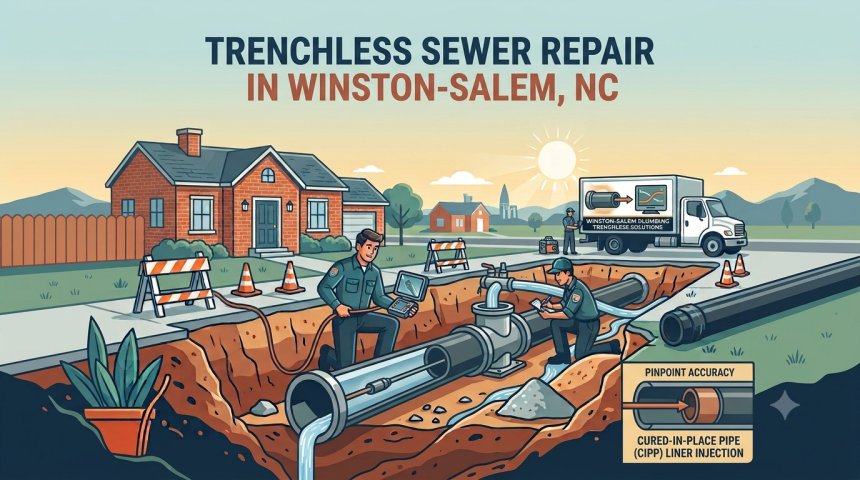
Trenchless Sewer Repair in Winston-Salem, NC
Sewer line problems can be difficult and disruptive because underground pipes may run beneath driveways, landscaping, patios, sidewalks, or other areas of a property. Traditional sewer replacement may require excavation to access the damaged pipe.
Professional trenchless sewer repair in Winston-Salem, NC can provide an alternative approach for certain sewer line problems. Depending on the condition and layout of the existing pipe, trenchless methods may allow repair or replacement with significantly less surface excavation than conventional methods.
Not every sewer line is suitable for trenchless work, so professional inspection is important before choosing a repair method.
What Is Trenchless Sewer Repair?
Trenchless sewer repair refers to methods that can repair or replace underground sewer pipes while minimizing the need for continuous excavation along the entire pipe.
Instead of opening a long trench from one end of the damaged sewer line to another, specialized equipment may use existing access points or strategically placed openings.
The exact method depends on the pipe condition, location, length, material, and surrounding property.
Common Sewer Problems That May Require Repair
Trenchless methods may be considered for several sewer line problems, including:
- Cracked pipes
- Broken sewer lines
- Root intrusion
- Deteriorated pipes
- Separated joints
- Recurring sewer blockages
- Aging underground sewer lines
- Certain collapsed or damaged sections
A camera inspection can help determine the condition of the existing pipe before a repair method is selected.
How Trenchless Sewer Repair Works
There are different trenchless technologies, and the process varies according to the type of repair.
Two commonly discussed approaches include pipe lining and pipe bursting.
Pipe Lining
Pipe lining involves installing a flexible liner inside an existing sewer pipe.
The liner is positioned within the damaged section and formed into a new pipe-like interior.
This can create a new inner surface while using much of the existing pipe's pathway.
Pipe lining may be considered when the existing pipe has suitable dimensions and structural conditions.
Pipe Bursting
Pipe bursting is a trenchless replacement method in which specialized equipment breaks apart the existing pipe while pulling a new pipe into the resulting pathway.
This approach can be useful when the existing sewer line needs replacement and site conditions allow the equipment to be used effectively.
Benefits of Trenchless Sewer Repair
One major advantage of trenchless methods is reduced excavation.
Potential benefits may include:
- Less disturbance to landscaping
- Reduced disruption to driveways or paved areas
- Fewer large excavation areas
- Potentially faster site restoration
- Access to difficult underground areas
- Less surface disruption compared with some traditional methods
The actual benefits depend on the property and selected repair technique.
Is Trenchless Sewer Repair Completely Dig-Free?
The term "trenchless" does not necessarily mean that absolutely no digging will occur.
Some trenchless projects may require access points or small excavations to introduce equipment or connect the new pipe.
However, the amount of surface excavation can be substantially less than with conventional open-trench replacement in suitable situations.
Trenchless vs. Traditional Sewer Repair
Traditional sewer replacement typically involves excavating along the affected sewer line to expose the damaged pipe.
Trenchless repair aims to minimize this excavation.
The best method depends on:
- Pipe condition
- Sewer line location
- Pipe size
- Existing material
- Depth
- Accessibility
- Property layout
- Type of damage
A professional assessment can help compare the available options.
Sewer Camera Inspection Before Trenchless Repair
A sewer camera inspection is often useful before major sewer repair.
The camera can help identify:
- Cracks
- Root intrusion
- Blockages
- Pipe separation
- Structural deterioration
- Other visible conditions
This information can help determine whether trenchless repair is technically appropriate.
When Trenchless Repair May Not Be Suitable
Trenchless methods are not ideal for every sewer problem.
Factors that may affect suitability include:
- Severe pipe collapse
- Unusual pipe configuration
- Inadequate access
- Incorrect pipe dimensions
- Significant changes in pipe direction
- Certain connection problems
- Site-specific structural limitations
A professional should evaluate the existing sewer line before recommending a trenchless solution.
Trenchless Sewer Repair for Older Homes
Older homes may have aging sewer pipes that experience recurring clogs, root intrusion, cracks, or other deterioration.
A camera inspection can help determine whether the existing sewer line is a candidate for trenchless repair or whether another solution would be more appropriate.
Trenchless Sewer Repair and Tree Roots
Tree roots can enter sewer lines through cracks and joints.
Trenchless repair may help address the damaged pipe depending on the extent and location of the root intrusion.
Removing the roots alone may only provide temporary relief if the entry point remains open.
How Much Does Trenchless Sewer Repair Cost?
The cost varies according to the project.
Factors can include:
- Sewer line length
- Pipe diameter
- Pipe depth
- Repair method
- Existing pipe condition
- Property accessibility
- Number of access points
- Labor and equipment
- Surface conditions
Trenchless repair may have different upfront costs than traditional excavation, but the total project impact should be evaluated based on the entire scope of work.
Trenchless Sewer Repair Process
A typical project may include:
Inspection
The sewer line is inspected to identify the problem.
Evaluation
The plumber determines whether trenchless repair is technically feasible.
Access Preparation
Appropriate access points are prepared.
Repair or Replacement
The selected trenchless method is performed using specialized equipment.
Connection Work
The repaired line is connected to the property's existing plumbing system.
Testing
The sewer line is tested to confirm proper flow.
Final Inspection
Additional inspection may be performed to evaluate the completed work.
Maintenance After Trenchless Sewer Repair
A repaired sewer line still requires appropriate use and maintenance.
Homeowners should:
- Avoid flushing unsuitable items
- Keep grease out of drains
- Address recurring drainage issues promptly
- Monitor sewer performance
- Schedule inspection if new symptoms appear
Proper maintenance can help protect the sewer system from future problems.
When to Consider Trenchless Sewer Repair
A professional evaluation may be appropriate when:
- A sewer pipe has structural damage
- Traditional excavation would significantly disrupt the property
- The sewer line runs beneath a driveway or landscaped area
- Recurring sewer problems suggest pipe deterioration
- A camera inspection identifies suitable damage
- The existing pipe is a candidate for trenchless technology
Frequently Asked Questions
What is trenchless sewer repair?
It is a group of sewer repair or replacement methods designed to minimize excavation compared with traditional open-trench techniques.
Is trenchless sewer repair completely underground?
The work takes place primarily through underground access, but some excavation may still be necessary for equipment and connections.
Is trenchless repair suitable for every sewer line?
No. Pipe condition, size, layout, accessibility, and the type of damage all affect whether trenchless repair is possible.
Does trenchless sewer repair replace the old pipe?
Some trenchless methods create a new pipe inside the existing line, while others replace the old pipe through techniques such as pipe bursting.
How long does trenchless sewer repair take?
The timeline depends on pipe length, repair method, access, site conditions, and the extent of the problem.
Final Thoughts
Underground sewer repairs do not always require a large open trench across the property. Depending on the sewer line and type of damage, trenchless technology may provide a less disruptive repair or replacement option.
Professional trenchless sewer repair in Winston-Salem, NC can help address certain damaged sewer lines while minimizing surface excavation. A sewer camera inspection and professional evaluation are important steps in determining whether this approach is suitable.
Share
What's Your Reaction?
 Like
0
 Dislike
0
 Love
0
 Funny
0
 Angry
0
 Sad
0
 Wow
0